UAS-CoRa Radiocommunications
Observatory
SPECTRUM POLICY
In this place are considered aspects relevant and related with spectrum resource today. Two questions: Is it possible to "run out of spectrum"? What is the "spectrum crunch"?
Two sources for answers: The ITU-R Regulations/Recommendations and Spectrum policy in the European Union
ITU-R promoted the WRC-2012 World Radio communication Conference 2012 (WRC-12) and it is the event more important for Radio communications industry and electronic communications regulators. It was held from 23 January-17 February 2012 in Geneva, Switzerland. Agenda, Resolutions and Recommendations may be followed in the link http://www.itu.int/ITU-R/Resolutions and Recommendations about UAS radio communications and HAPS using 5 GHz bands are hoped.( Source ITU-R)
Spectrum policy in the European Union (Source UE)
The Commission plays a key role in achieving the Single Market. On this basis, the role and competencies of the European Commission in spectrum policy are laid down in the Radio Spectrum Decision 676/2002/EC. The purpose of this Decision was to establish a policy and legal framework in the European Union in order to coordinate and support the harmonisation of radio spectrum use where this is needed at EU level. Harmonisation measures are adopted via an process involving the Radio Spectrum Committee..
Proposal for a first radio spectrum policy programme(Source UE)
The Commission presented on 20 September 2010 a draft programme which sets out policy orientations and objectives for the strategic planning and harmonisation of spectrum use to achieve the internal market. It supports the Europe 2020 Strategy and the Digital Agenda for Europe and promotes EU policies using spectrum beyond electronic communications. It sets concrete priority initiatives for enhanced coordination, flexibility, and availability of spectrum for wireless broadband communications and other specific EU policies. Increasingly next-generation radio access technologies such as Cognitive Radio (CR) and/or Software Defined Radio (SDR) promise to improve the opportunities to share spectrum access efficiently.
UAS (Unmanned Aeronautical System-Aircraft and Ballons)
This Unmanned aerial vehicle (UAV) is the more important subsystem of the UAS system in the world and has possible use for Broadband communication. AeroVironment (USA) is important contractor for Defense in USA .This company was the first in the world for developing HALE vehicles (HAPS) for civil Telecommunications. This comment is related with the importance of this market in the USA (Innovation and new ideas) where the reuse of the DRONE technology for civil applications ( Telecommunications, Remote sensing, Border control, Fire, Earthquakes, etc.) is a market in expansion.
The discussion continues in Europe .From the point of view of the European Union the Actions and Strategy for Unmanned Aircraft Systems technology may be summarized as follow (The more advanced...):
On 16 November 2011, the Commission organized the fourth workshop of the UAS Panel Process aiming at preparing a Strategy for UAS in Europe. After a first workshop dedicated to UAS industry and market, a second workshop dedicated to UAS insertion into air traffic and radio frequencies, and a third workshop focusing on issues related to safety of UAS, the fourth workshop dealt with the societal dimension of the use of UAS for civil applications: responsibility, liability, insurance, privacy and data protection as well as societal acceptance.The workshop discussed, among others, the issue of third party liability in the case of incidents involving UAS, the current data and privacy protection rules applicable for data gathering carried out by UAS as well as the conditions for the public acceptance of UAS flying in European airspace. The workshop concluded that the current legal framework governing privacy protection, data processing and liability, is applicable and might only need small adjustments to accommodate for the specificities of UAS technology. on the momentum created by the first four workshops, the Commission is preparing the fifth workshop which will deal with technology gaps, research needs and the general research framework for UAS in Europe. The next UAS R&D workshop, which takes place on 9 February 2012 in Brussels. (Source EU docs.)
"Unfortunately there is no one European programme," says chief executive Louis Gallois. "When countries are cutting defense budgets, they need to work together to develop programmes, as this is the only way for Europe to keep its autonomy on sovereign equipment. We need a Europe-wide programme for UAVs. Having two is not an efficient way for saving money." The lasts projects of the UE (5th and 6th programs)for civil UAVs (denominated HAPS) are from 2006 year.
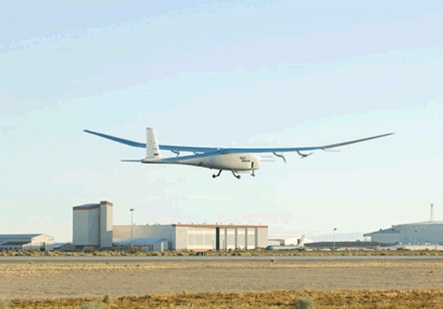
Source: Global Observer for civil applications (CUAS) from AeroVironment (USA)
COGNITIVE RADIO
KEY WRC-12 HIGHLIGHTS
The Final Acts of the World Radiocommunication Conference 2012 (WRC-12) were signed in Geneva on Friday, 17 February, and for that reason this section includes a brief resume about what was resolved concerning the cognitive radio technology.
F.1 AGENDA ITEM 1.17 (Digital Dividend)
The UHF spectrum from 790MHz to 862MHz (“the 800MHz band”) was allocated in Europe and Africa to mobile services on a co-primary basis with terrestrial television28.
In this regard, beyond the use of the bands encompassed by the so called digital divided, the WRC-12 has also considered the allocation of the frequency band from 694MHz to 790MHz (“the 700MHz band”) in Europe and Africa, which leads to a second digital dividend that could provide a kind of spectrum alignment with respect to other world regions (e.g., Asia and the Americas).
So, the above mentioned issue has been scheduled for the WRC-15 along with the need of considering the allocation of even more spectrum aiming at satisfying the needs of the broadband wireless systems.
F.2 AGENDA ITEM 1.19 (Software Defined Radio & Cognitive Radio)
The protection of the existing radiocommunication services from potential interference coming from software defined radios and cognitive radios has been a primary concern, and that’s why the WRC-12 through the AI 1.19 considered regulatory measurements and their relevance aiming at enabling the introduction of this technologies, this based on the results of ITU-R studies in accordance with resolution 956 (WRC-07).
In this respect, before the WRC-12 took place, the ITU-R Working Party 1B pointed out that these technologies can be deployed independently, combined, and that can even be implemented in systems of any radiocommunication service (i.e., they would be adhered to the RR rules in question.)
Taking the above into consideration, in a broad sense, the Agenda Item 1.19 at the WRC-12 was solved as follows.
Committee 6 (COM 6) concluded that the Software Defined Radio neither the Cognitive Radio won’t lead to changing the Radio Regulations, and that the Resolution 956 would be suppressed. Concretely, in the case of the Cognitive Radio technology, the CoRa’s will have to adopt the ITU-R Recommendations.